Google Tech Talk Gerd Leonhard on The Future (Video)
Gerd Leonhard is a Music & Media Futurist, Author, Speaker, Advisor, and Digital Media Entrepreneur. The Wall Street Journal calls Gerd one of the leading media futurists in the world. He is the Co-Author of the influential book "The Future of Music" (2005, Berklee Press), as well as the author of "Music2.0" (released 2/2008 www.music20book.com), and of "Open is King - The Future of Media beyond Control" (late 2008).
Monday, March 30, 2009

New Legislation Authorizes FEMA Camps In U.S.

A new bill introduced in Congress authorizes the Department of Homeland Security to set up a network of FEMA camp facilities to be used to house U.S. citizens in the event of a national emergency.
The National Emergency Centers Act or HR 645 mandates the establishment of “national emergency centers” to be located on military installations for the purpose of to providing “temporary housing, medical, and humanitarian assistance to individuals and families dislocated due to an emergency or major disaster,” according to the bill.
The legislation also states that the camps will be used to “provide centralized locations to improve the coordination of preparedness, response, and recovery efforts of government, private, and not-for-profit entities and faith-based organizations”.
Ominously, the bill also states that the camps can be used to “meet other appropriate needs, as determined by the Secretary of Homeland Security,” an open ended mandate which many fear could mean the forced detention of American citizens in the event of widespread rioting after a national emergency or total economic collapse.
Many credible forecasters have predicted riots and rebellions in America that will dwarf those already witnessed in countries like Iceland and Greece.
With active duty military personnel already being stationed inside the U.S. under Northcom, partly for purposes of “crowd control,” fears that Americans could be incarcerated in detainment camps are all too real.
The bill mandates that six separate facilities be established in different Federal Emergency Management Agency Regions (FEMA) throughout the country.
The camps will double up as “command and control” centers that will also house a “24/7 operations watch center” as well as training facilities for Federal, State, and local first responders.
The bill also contains language that will authorize camps to be established within closed or already operating military bases around the country.
As we have previously highlighted, in early 2006 Halliburton subsidiary Kellogg, Brown and Root was awarded a $385 million dollar contract by Homeland Security to construct detention and processing facilities in the event of a national emergency.
The language of the preamble to the agreement veils the program with talk of temporary migrant holding centers, but it is made clear that the camps would also be used “as the development of a plan to react to a national emergency.”
As far back as 2002, FEMA sought bids from major real estate and engineering firms to construct giant internment facilities in the case of a chemical, biological or nuclear attack or a natural disaster.
A much discussed and circulated report, the Pentagon’s Civilian Inmate Labor Program, was more recently updated and the revision details a “template for developing agreements” between the Army and corrections facilities for the use of civilian inmate labor on Army installations.”
Alex Jones has attended numerous military urban warfare training drills across the US where role players were used to simulate arresting American citizens and taking them to internment camps.
Read the new legislation in full below.
————————————————————————
National Emergency Centers Establishment Act (Introduced in House)
HR 645 IH
111th CONGRESS
1st Session
H. R. 645
To direct the Secretary of Homeland Security to establish national emergency centers on military installations.
IN THE HOUSE OF REPRESENTATIVES
January 22, 2009
Mr. HASTINGS of Florida introduced the following bill; which was referred to the Committee on Transportation and Infrastructure, and in addition to the Committee on Armed Services, for a period to be subsequently determined by the Speaker, in each case for consideration of such provisions as fall within the jurisdiction of the committee concerned
——————————————————————————–
A BILL
To direct the Secretary of Homeland Security to establish national emergency centers on military installations.
Be it enacted by the Senate and House of Representatives of the United States of America in Congress assembled,
SECTION 1. SHORT TITLE.
This Act may be cited as the `National Emergency Centers Establishment Act’.
SEC. 2. ESTABLISHMENT OF NATIONAL EMERGENCY CENTERS.
(a) In General- In accordance with the requirements of this Act, the Secretary of Homeland Security shall establish not fewer than 6 national emergency centers on military installations.
(b) Purpose of National Emergency Centers- The purpose of a national emergency center shall be to use existing infrastructure–
(1) to provide temporary housing, medical, and humanitarian assistance to individuals and families dislocated due to an emergency or major disaster;
(2) to provide centralized locations for the purposes of training and ensuring the coordination of Federal, State, and local first responders;
(3) to provide centralized locations to improve the coordination of preparedness, response, and recovery efforts of government, private, and not-for-profit entities and faith-based organizations; and
(4) to meet other appropriate needs, as determined by the Secretary of Homeland Security.
SEC. 3. DESIGNATION OF MILITARY INSTALLATIONS AS NATIONAL EMERGENCY CENTERS.
(a) In General- Not later than 60 days after the date of the enactment of this Act, the Secretary of Homeland Security, in consultation with the Secretary of Defense, shall designate not fewer than 6 military installations as sites for the establishment of national emergency centers.
(b) Minimum Requirements- A site designated as a national emergency center shall be–
(1) capable of meeting for an extended period of time the housing, health, transportation, education, public works, humanitarian and other transition needs of a large number of individuals affected by an emergency or major disaster;
(2) environmentally safe and shall not pose a health risk to individuals who may use the center;
(3) capable of being scaled up or down to accommodate major disaster preparedness and response drills, operations, and procedures;
(4) capable of housing existing permanent structures necessary to meet training and first responders coordination requirements during nondisaster periods;
(5) capable of hosting the infrastructure necessary to rapidly adjust to temporary housing, medical, and humanitarian assistance needs;
(6) required to consist of a complete operations command center, including 2 state-of-the art command and control centers that will comprise a 24/7 operations watch center as follows:
(A) one of the command and control centers shall be in full ready mode; and
(B) the other shall be used daily for training; and
(7) easily accessible at all times and be able to facilitate handicapped and medical facilities, including during an emergency or major disaster.
(c) Location of National Emergency Centers- There shall be established not fewer than one national emergency center in each of the following areas:
(1) The area consisting of Federal Emergency Management Agency Regions I, II, and III.
(2) The area consisting of Federal Emergency Management Agency Region IV.
(3) The area consisting of Federal Emergency Management Agency Regions V and VII.
(4) The area consisting of Federal Emergency Management Agency Region VI.
(5) The area consisting of Federal Emergency Management Agency Regions VIII and X.
(6) The area consisting of Federal Emergency Management Agency Region IX.
(d) Preference for Designation of Closed Military Installations- Wherever possible, the Secretary of Homeland Security, in consultation with the Secretary of Defense, shall designate a closed military installation as a site for a national emergency center. If the Secretaries of Homeland Security and Defense jointly determine that there is not a sufficient number of closed military installations that meet the requirements of subsections (b) and (c), the Secretaries shall jointly designate portions of existing military installations other than closed military installations as national emergency centers.
(e) Transfer of Control of Closed Military Installations- If a closed military installation is designated as a national emergency center, not later than 180 days after the date of designation, the Secretary of Defense shall transfer to the Secretary of Homeland Security administrative jurisdiction over such closed military installation.
(f) Cooperative Agreement for Joint Use of Existing Military Installations- If an existing military installation other than a closed military installation is designated as a national emergency center, not later than 180 days after the date of designation, the Secretary of Homeland Security and the Secretary of Defense shall enter into a cooperative agreement to provide for the establishment of the national emergency center.
(g) Reports-
(1) PRELIMINARY REPORT- Not later than 90 days after the date of the enactment of this Act, the Secretary of Homeland Security, acting jointly with the Secretary of Defense, shall submit to Congress a report that contains for each designated site–
(A) an outline of the reasons why the site was selected;
(B) an outline of the need to construct, repair, or update any existing infrastructure at the site;
(C) an outline of the need to conduct any necessary environmental clean-up at the site;
(D) an outline of preliminary plans for the transfer of control of the site from the Secretary of Defense to the Secretary of Homeland Security, if necessary under subsection (e); and
(E) an outline of preliminary plans for entering into a cooperative agreement for the establishment of a national emergency center at the site, if necessary under subsection (f).
(2) UPDATE REPORT- Not later than 120 days after the date of the enactment of this Act, the Secretary of Homeland Security, acting jointly with the Secretary of Defense, shall submit to Congress a report that contains for each designated site–
(A) an update on the information contained in the report as required by paragraph (1);
(B) an outline of the progress made toward the transfer of control of the site, if necessary under subsection (e);
(C) an outline of the progress made toward entering a cooperative agreement for the establishment of a national emergency center at the site, if necessary under subsection (f); and
(D) recommendations regarding any authorizations and appropriations that may be necessary to provide for the establishment of a national emergency center at the site.
(3) FINAL REPORT- Not later than 1 year after the date of the enactment of this Act, the Secretary of Homeland Security, acting jointly with the Secretary of Defense, shall submit to Congress a report that contains for each designated site–
(A) finalized information detailing the transfer of control of the site, if necessary under subsection (e);
(B) the finalized cooperative agreement for the establishment of a national emergency center at the site, if necessary under subsection (f); and
(C) any additional information pertinent to the establishment of a national emergency center at the site.
(4) ADDITIONAL REPORTS- The Secretary of Homeland Security, acting jointly with the Secretary of Defense, may submit to Congress additional reports as necessary to provide updates on steps being taken to meet the requirements of this Act.
SEC. 4. LIMITATIONS ON STATUTORY CONSTRUCTION.
This Act does not affect–
(1) the authority of the Federal Government to provide emergency or major disaster assistance or to implement any disaster mitigation and response program, including any program authorized by the Robert T. Stafford Disaster Relief and Emergency Assistance Act (42 U.S.C. 5121 et seq.); or
(2) the authority of a State or local government to respond to an emergency.
SEC. 5. AUTHORIZATION OF APPROPRIATIONS.
There is authorized to be appropriated $180,000,000 for each of fiscal years 2009 and 2010 to carry out this Act. Such funds shall remain available until expended.
SEC. 6. DEFINITIONS.
In this Act, the following definitions apply:
(1) CLOSED MILITARY INSTALLATION- The term `closed military installation’ means a military installation, or portion thereof, approved for closure or realignment under the Defense Base Closure and Realignment Act of 1990 (part A of title XXIX of Public Law 101-510; 10 U.S.C. 2687 note) that meet all, or 2 out of the 3 following requirements:
(A) Is located in close proximity to a transportation corridor.
(B) Is located in a State with a high level or threat of disaster related activities.
(C) Is located near a major metropolitan center.
(2) EMERGENCY- The term `emergency’ has the meaning given such term in section 102 of the Robert T. Stafford Disaster Relief and Emergency Assistance Act (42 U.S.C. 5122).
(3) MAJOR DISASTER- The term `major disaster’ has the meaning given such term in section 102 of the Robert T. Stafford Disaster Relief and Emergency Assistance Act (42 U.S.C. 5122).
(4) MILITARY INSTALLATION- The term `military installation’ has the meaning given such term in section 2910 of the Defense Base Closure and Realignment Act of 1990 (part A of title XXIX of Public Law 101-510; 10 U.S.C. 2687 note).
Research related articles:
- Rangel To Push Universal Military Draft Legislation Once More
- FEMA sources confirm coming martial law
- The failure of the NIST WTC 7 report to address concerns raised in Appendix C of the 2002 FEMA Building Performance Study
- Treasury Sends to Congress Legislation to Buy Troubled Assets
- Pentagon to Detail Troops to Bolster Domestic Security
- Hurricane Gustav: National Emergency Environment Sets the Stage for the McCain Election Campaign
- NIST Concludes “Fire” Caused WTC 7 “Collapse” when FEMA Report Concluded Fuel Tank Explosion had “low probability” of Knocking Down Tower
- Military Examines Role In Domestic Defense
- Torture Camps Minutes From Olympic Sites
- U.S. troops may be deployed in Arizona, Southwest U.S.
- List of Labor Camps Released to International Journalists in China
- There Might Be a Financial Crisis, But the World’s Arms Dealers Are Doing Just Fine
Indigenous Native American Prophecy (Video)
History tells of cultures that grew and flourished, only to disappear or turn to dust. Some have left behind accounts of the catastrophes that destroyed them.
The question is whether we will experience the same fate. Will the earth end up as a barren planet, razed to the ground by nuclear weapons, earthquakes, or floods? Has it happened before? Will it all happen again, as prophets have so often predicted? Or is there still hope for us all?
The question is whether we will experience the same fate. Will the earth end up as a barren planet, razed to the ground by nuclear weapons, earthquakes, or floods? Has it happened before? Will it all happen again, as prophets have so often predicted? Or is there still hope for us all?
Healthy Eating: Artificial food additives affect children’s behavior
Years of research finally supports what many parents already knew: Junk foods – loaded with artificial food dyes and preservatives – cause behavioral problems in children.
Research from a study of 297 children published in The Lancet found a significant number of children became more inattentive, impulsive and hyperactive when given a test drink with artificial additives. (The subjects were from the general population, not diagnosed with attention deficit hyperactivity disorder.) In England, where the study was conducted, people are calling for the additives to be banned from the food supply because the effects can lead to reading and other problems in school.
In the U.S., doctors are advising parents to check and possibly change their child’s diet before considering ADHD drugs.
In the February edition of The American Academy of Pediatrics Grand Rounds, two medical experts praised the current research and advised pediatricians to recommend ``a trial of preservative-free, food coloring-free diet'' when a child is hyperactive.
The connection between food additives and behavior was noted more than 30 years ago by an allergist, Ben Feingold. He also hypothesized certain children were sensitive to foods with salicylates, compounds similar to aspirin. He recommended trying an elimination diet and documented hundreds of case studies in which behavior improved.
Although rigorous research on the Feingold program is lacking, current research is substantiating many aspects of it. Fervent believers in Feingold’s methods support and manage the nonprofit Feingold Association. (www.feingold.org). In addition to salicylates, The Feingold Program recommends eliminating from the diet: all artificial (synthetic) colors, listed on the label as ``food coloring'', ``color added'' or by its FDA number, like FD&C Yellow #5 or FD&C Red #40 (both used in the Lancet study); artificial flavors listed as ``flavoring'' or ``artificial flavoring'' or artificial vanilla (vanillin); aspartame (an artificial sweetener); and three preservatives, BHA, BHT, and TBHQ – already removed from most food for children in the U.K.
Many children’s cereals contain BHT and artificial colors but Cheerios, Honey Nut Cheerios, Kashi, Barbara’s, and Trader Joe’s brands do not. Yogurts, like Stonyfield or Trader Joe’s, do not have artificial colors. Plain tortilla or potato chips trump artificially colored Doritos, barbeque potato chips or orange cheese curls. Choose clear Gatorade, Capri Sun Sport, or dilute natural juice (in half) with water for young athletes. Dye-free Motrin or Benadryl are also available now.
Related: It's Official: TV Linked to Attention Deficit Hyperactivity Disorder
The Truth Behind the Vaccine Cover-up
MSG Causes Most Obesity In US And Canada
Hidden Sources Of MSG In Foods
Sweet Misery: A Poisoned World
Aspartame - The Silent Killer
The Effects Of Fluoride On The Thyroid Gland
Fluoride & the Pineal Gland: Study Published in Caries Research
Psychiatry and the Schools: Mental Hygiene in the 21 st Century
Todays Children - Soldiers Of Tomorrow
Death from Ritalin - The Truth Behind ADHD
Vegan lifestyle good for the heart, body, soul and mind
Organic and vegan eating spawn good health, sustainable environment
Vegan lifestyle lessens effects of factory farms
Research from a study of 297 children published in The Lancet found a significant number of children became more inattentive, impulsive and hyperactive when given a test drink with artificial additives. (The subjects were from the general population, not diagnosed with attention deficit hyperactivity disorder.) In England, where the study was conducted, people are calling for the additives to be banned from the food supply because the effects can lead to reading and other problems in school.
In the U.S., doctors are advising parents to check and possibly change their child’s diet before considering ADHD drugs.
In the February edition of The American Academy of Pediatrics Grand Rounds, two medical experts praised the current research and advised pediatricians to recommend ``a trial of preservative-free, food coloring-free diet'' when a child is hyperactive.
The connection between food additives and behavior was noted more than 30 years ago by an allergist, Ben Feingold. He also hypothesized certain children were sensitive to foods with salicylates, compounds similar to aspirin. He recommended trying an elimination diet and documented hundreds of case studies in which behavior improved.
Although rigorous research on the Feingold program is lacking, current research is substantiating many aspects of it. Fervent believers in Feingold’s methods support and manage the nonprofit Feingold Association. (www.feingold.org). In addition to salicylates, The Feingold Program recommends eliminating from the diet: all artificial (synthetic) colors, listed on the label as ``food coloring'', ``color added'' or by its FDA number, like FD&C Yellow #5 or FD&C Red #40 (both used in the Lancet study); artificial flavors listed as ``flavoring'' or ``artificial flavoring'' or artificial vanilla (vanillin); aspartame (an artificial sweetener); and three preservatives, BHA, BHT, and TBHQ – already removed from most food for children in the U.K.
Many children’s cereals contain BHT and artificial colors but Cheerios, Honey Nut Cheerios, Kashi, Barbara’s, and Trader Joe’s brands do not. Yogurts, like Stonyfield or Trader Joe’s, do not have artificial colors. Plain tortilla or potato chips trump artificially colored Doritos, barbeque potato chips or orange cheese curls. Choose clear Gatorade, Capri Sun Sport, or dilute natural juice (in half) with water for young athletes. Dye-free Motrin or Benadryl are also available now.
Related: It's Official: TV Linked to Attention Deficit Hyperactivity Disorder
The Truth Behind the Vaccine Cover-up
MSG Causes Most Obesity In US And Canada
Hidden Sources Of MSG In Foods
Sweet Misery: A Poisoned World
Aspartame - The Silent Killer
The Effects Of Fluoride On The Thyroid Gland
Fluoride & the Pineal Gland: Study Published in Caries Research
Psychiatry and the Schools: Mental Hygiene in the 21 st Century
Todays Children - Soldiers Of Tomorrow
Death from Ritalin - The Truth Behind ADHD
Vegan lifestyle good for the heart, body, soul and mind
Organic and vegan eating spawn good health, sustainable environment
Vegan lifestyle lessens effects of factory farms
British scientists to create synthetic blood
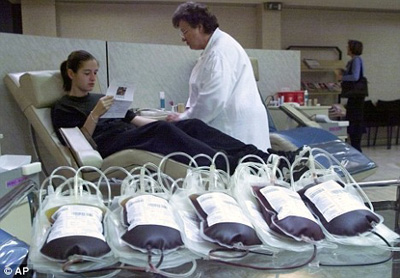
A major research project is to be announced this week that will culminate in three years with the first transfusions into human volunteers of "synthetic" blood made from the stem cells of spare IVF embryos. It could help to save the lives of anyone from victims of traffic accidents to soldiers on a battlefield by revolutionising the vital blood transfusion services, which have to rely on a network of human donors to provide a constant supply of fresh blood.
The multimillion-pound deal involving NHS Blood and Transplant, the Scottish National Blood Transfusion Service and the Wellcome Trust, the world's biggest medical research charity, means Britain will take centre stage in the global race to develop blood made from embryonic stem cells. The researchers will test human embryos left over from IVF treatment to find those that are genetically programmed to develop into the "O-negative" blood group, which is the universal donor group whose blood can be transfused into anyone without fear of tissue rejection.
This blood group is relatively rare, applicable to about 7 per cent of the population, but it could be produced in unlimited quantities from embryonic stem cells because of their ability to multiply indefinitely in the laboratory.
The aim is to stimulate embryonic stem cells to develop into mature, oxygen-carrying red blood cells for emergency transfusions. Such blood would have the benefit of not being at risk of being infected with viruses such as HIV and hepatitis, or the human form of "mad cow" disease. The military in particular needs a constant supply of fresh, universal donor blood for battlefield situations when normal supplies from donors can quickly run out.
But developing blood made from the cells of spare IVF embryos will raise difficult ethical issues for people not happy with the idea of destroying embryos to create stem cells. It also raises the intriguing philosophical question of whether the synthetic blood will have come from someone who never existed. In theory, just one embryo could meet the nation's needs.
The Wellcome Trust is believed to have promised £3m towards the cost of the project, with further funding coming from the blood transfusion services of Scotland, and England and Wales. The Irish government is also understood to be involved. A spokesman for the Wellcome Trust said complicated legal issues were still being ironed out between all the parties involved but that an announcement is likely to be made in the coming week.
The project will be led by Professor Marc Turner, of Edinburgh University, the director of the Scottish National Blood Transfusion Service. Professor Turner has been involved in studies investigating how to ensure donated blood is free of the infectious agent behind variant CJD, the human form of "mad cow" disease. Several vCJD patients are thought to have contracted the disease by blood transfusions.
Professor Turner was unavailable for comment but a spokeswoman for the National Blood Service for England and North Wales confirmed that negotiations on the joint research project were at an advanced stage and that legal, rather than scientific, issues were holding up the announcement.
The multi-centre collaboration is also understood to involve scientists at the Medical Research Council's Centre for Regenerative Medicine at the University of Edinburgh, and Roslin Cells, a spin-off company that has emerged out of the Roslin Institute, where Dolly the sheep was cloned in 1996.
Scientists in other countries, notably Sweden, France and Australia, are also known to be working on the development of synthetic blood from embryonic stem cells. And last year, a team from a US biotechnology company, Advanced Cell Technology, announced that it has been able to produce billions of functioning red blood cells from embryonic stem cells. But the US work had been held up because of funding problems dating back to the ban on embryonic stem cell work under the Bush administration. President Barack Obama has since reversed that policy.
In Britain, the project was held up because of the difficulty of finding funding for "translational" research that attempts to take scientific studies in the laboratory into the earliest stages of commercial development. This problem has now been overcome.
New Artificial DNA Points to Alien Life
CHICAGO — A strange, new genetic code a lot like that found in all terrestrial life is sitting in a beaker full of oily water in a laboratory in Florida, a scientist said today, calling it the first example of an artificial chemical system that is capable of Darwinian evolution.
The system is made of the four molecules that are the basic building blocks of our DNA along with eight synthetic modifications of them, said biochemist Steven A. Benner of the Foundation for Applied Molecular Evolution in Gainesville.
The main difference between the synthetic molecules and those that make up conventional DNA is that Benner's molecules cannot make copies of themselves, although that is just "a couple of years" away, he said.
The wild biochemistry finding, described to a small group of reporters today at the annual meeting of the American Association for the Advancement of Science, offers ideas about new types of life for scientists to look for beyond our planet, or even possibly hidden on our planet.
"Unless it happens to shoot at you with a ray gun, the life that you encounter off of Earth will not necessarily have same biochemistry as us," Benner said.
And the step from Benner's system to something that could be called artificial life is still large. "There is not enough information in them to build organisms," Benner said.
Expanded alphabet for DNA
For some 20 years, Benner's labs have been involved in trying to make artificial life or things approximating it, with similar genetic and inheritance properties to life on Earth. (Previously, Benner worked at the University of Florida.)
He and his colleagues have focused in part on expanding the DNA alphabet to develop an "Artificially Expanded Genetic Information System," which now has its own supporting molecular biology.
The building blocks of DNA are four chemicals called nucleotides that are referred to as A, C, T and G, for short. The nucleotides pair up and bond in predictable ways to form the double helix structure of DNA. Benner's new nucleotides, which he and his colleagues have named Z, P, V, J, Iso-C, Iso-G, X and K, are reshufflings of the constituents of those molecules found in our DNA.
The evolution in this system happens when the 12-letter genetic code makes copying mistakes and subsequent sequences have properties that make them more liable to get copied. Those sequences would survive in greater numbers than the original sequence.
Benner's synthetic approach was conceptualized using "ball and stick plastic model chemistry," he said, the technique used by James Watson and Francis Crick to arrive at the structure of the DNA molecule in 1953.
The human genome's DNA includes 3 billion base pairs. Some of the molecules synthesized in Benner's lab are 81 base pairs long — relatively short.
The molecules are "fed" and grow via a process called the polymerase chain reaction (PCR) that allows the molecules to make copies of themselves. Once the replication of the molecules in Benner's system is self-catalyzed, without PCR, the process is self-sustaining. Benner claims, "then it's artificial life."
Dreaming up extra-terrestrial life
The research resulted from a NASA-funded project to try to understand what life might look like beyond Earth. Such life might live in water, but it could also live in liquid nitrogen or methane (as speculated for Saturn's moon Titan) and in environments with extremely high or low acidity.
The results are published in a technical book, "Life, the Universe and the Scientific Method," of which Benner has made about 100 copies to distribute to his colleagues.
"One of the ways scientists try to understand life as a universal concept ... is you try to make life on your own in the lab," Benner said. "We try to put together chemicals that do that."
Any potential life forms made from such molecules would be "so alien in terms of their biochemistry that they will not able to eat you," Benner said.
NASA has been involved in searching for extra-terrestrial life along numerous avenues for decades, including the Viking mission to Mars in the 1970s and its recent missions to the red planet which have searched for signs of habitability there. NASA also funds an Astrobiology Institute, which partners with hundreds of researchers world-wide who study of the origins, evolution, distribution and future of life in the universe
The trick to searching for alien life is how to look for it, said Paul Davies of Arizona State University, who also spoke with reporters here today.
"All of the techniques which microbiologists use to [look for alien life] are customized to life as we know it," Davies said. "It's no surprise that microbiologists haven't come across micro-organisms that seem to have relatively different biochemistry."
In the future, more scientists could "talk with Steve Benner," Davies said, "to come up with perfectly good molecules that life could use — but doesn't."
Sunday, March 29, 2009
Subscribe to:
Posts (Atom)